Seventh Edition by Daniel P. Raymer, Ph.D.
AIAA Education Series, Reston, VA
2024 ISBN-13: 978-1624107153
AIAA’s #1 Selling Textbook – 100,000+ Aerospace Engineers Can’t Be Wrong!

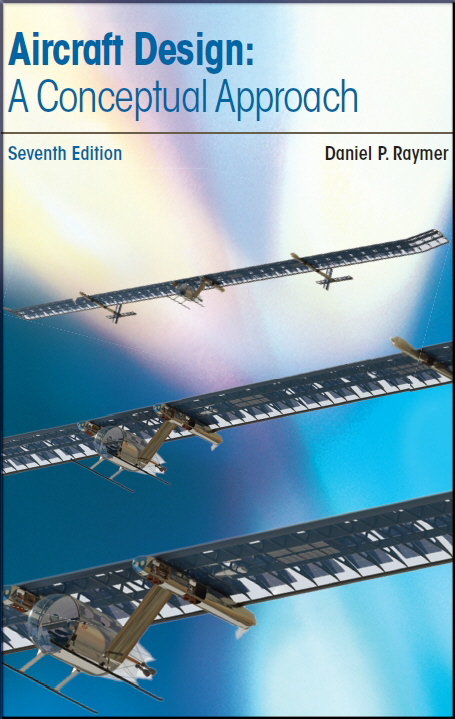
Dr. Raymer has done it again! This new seventh edition of his classic aircraft design textbook is updated, extensively rewritten, and adds new material on low R# flight, UAVs, electric aircraft, and even flight on Mars (see the cover). As always, Raymer’s textbook presents the entire process of aircraft conceptual design, from requirements definition through initial sizing, configuration layout, analysis, sizing, and trade studies, in the same manner seen in industry aircraft design groups.
Interesting and easy to read, AIRCRAFT DESIGN: A Conceptual Approach is the number one selling AIAA technical book (over 100,000 copies to date). Widely used in industry and government aircraft design groups, it has received the Aviation/Space Writers’ Association Award of Excellence and the prestigious AIAA Summerfield Book Award. A virtual encyclopedia of aircraft design engineering, it is known for its completeness, easy-to-read style, and real-world approach to the process of design.
In his monthly column, Peter Garrison of Flying Magazine recommended it as the best book for learning how to design an airplane. The book is in university use throughout the world, and is also a favorite of practicing design engineers who find it a trusty reference for a wide range of design information. As one measure of its utility and acceptance – well-worn copies are commonly seen at designers’ desks and in government aerospace offices.
AIAA’s Editorial Echoes column did an interesting interview with Daniel Raymer about the writing of the book and the award of the AIAA Summerfield Book Award.
NEW! How (and Why) Raymer wrote Aircraft Design: A Conceptual Approach
“Your book is one of the best books I have read in my life.” Stjepan Bedic, CEO at ETF Airways d.o.o., Zagreb, Croatia (2021)
“An amazing and wonderful book for Aircraft designer engineers. It teaches from ABC of aircarft design up to the most advanced knowledge on spacecraft design while given the right steps to follow in the design process. It’s just such a Great book, it is THE BOOK for aircraft design!”Haza Mikhael, Aircraft Maintenance Engineer at Air Congo
“Thumbs up on an excellent book. Wish I had it as an undergrad.” Greg Marien, Northrop Grumman Unmanned Systems
“It’s truly a treasure trove of information on Aircraft Design.” Chung Wang Cheung, Airbus Helicopters Hong Kong
“I have two copies of your book Aircraft Design: A Conceptual Approach. I keep one here and one at my home engineering office. I use it on every new design I work on.” August Bellanca, designer of the AviaBellanca Skyrocket and son of aviation pioneer Giuseppe Bellanca.
“It really helped me in understanding the process of designing an aircraft during the conceptual phase when I was at University. Those estimations/correlation methods you provided in the book to get a performance parameter for the aircraft when there isn’t any fixed design in the early stages of aircraft development are exceptional” Muhammad Sandy, GKN Aerospace (2023)
“…thank you for your aircraft design book. Being an aerospace engineering student it helps me a lot in my studies. Although our instructor insists on another book, which is really boring, almost 95 percent of our design class use your book.” (name withheld for obvious reasons!)
AIRCRAFT DESIGN: A Conceptual Approach is over a thousand pages of design methods, illustrations, tips, explanations and equations, and has useful appendices with the key data required by designers.
There is also the amazing and user-friendly RDSwin-Student aircraft design software which complements the text, automating the tedious analysis tasks allowing the students to spend more time learning the concept and philosophy of aircraft design. Click here for more information.
Table of Contents
Author’s Note
1 Design – A Separate Discipline
2 Overview Of The Design Process
3 Sizing From A Conceptual Sketch
4 Airfoil And Geometry Selection
5 Thrust-To-Weight Ratio And Wing Loading
6 Initial Sizing
7 Configuration Layout And Loft
8 Special Considerations In Configuration Layout
9 Crew Station, Payload, And Passengers
10 Propulsion And Fuel System
11 Landing Gear And Subsystems
| 12 Aerodynamics 13 Propulsion 14 Structures And Loads 15 Weights 16 Stability, Control, & Handling Qualities 17 Performance And Flight Mechanics 18 Cost Analysis 19 Sizing And Trade Studies 20 Electric Aircraft 21 Vertical Flight – Jet & Prop 22 Extremes Of Flight 23 Design Of Unique Aircraft Concepts 24 Conceptual Design Examples Appendices Examination/Homework Questions |
Errata for 6th Edition / 5th Edition (so far so good on the 7th edition!)
Amazon.com Book Review
Outstanding summary of conceptual aircraft design
A reader from Austin, Texas: Mr. Raymer has managed to explain a very complicated process in a way that is both understandable and interesting. Conceptual aircraft design (i.e., starting with nothing but a set of performance criteria to be met) is a multi-variable problem in which the value of most of the variables depend on other variables. The solution of such problems require initial approximations with subsequent iterations. Mr. Raymer explains the conceptual design process, gives historic values used for first approximations and makes good use of actual examples. Two conceptual designs, one a homebuilt aerobatic aircraft and the other a supersonic fighter, are provided in the Appendix to illustrate the procedures described in the book. I found the book interesting both in subject matter and writing style. Although written as a college textbook, the use of actual aircraft to illustrate various points and the author’s obvious desire to be precise about his descriptions makes the book easy to follow and fun to those interested in the subject.
AIRCRAFT DESIGN: A Conceptual Approach and the RDSwin-Student software are available from Amazon.com as follows:
Aircraft Design : A Conceptual Approach (7th edition)
RDSwin-Student : Software for Aircraft Design, Sizing and Performance
Or click here to order directly from the publisher (AIAA)
Notice: Many people have reported a problem with ordering Raymer’s textbook in Europe. It turns out that AIAA’s previous European distributor (Eurospan) went bankrupt! There is a new UK-based distributor, ScriptBooks. If your local distributor cannot get the book, have them contact ScriptBooks or do so yourself.